Friday, August 8, 2008

A Change of Scenery


It is not uncommon for an athlete to retire and work for NBC as a broadcaster. What is much more uncommon is for someone to do this in reverse. That is what happened to me, and the experience of working in the last Olympics has clearly given me a different perspective and appreciation for my experience now as an athlete.

Four years ago, I had an amazing opportunity arise. After failing to qualify for the 2004 Olympics, NBC hired me to work for them in Athens. It was bittersweet to be there watching others compete in an Olympics I thought would be my own, but working for NBC proved to be an awesome fallback.

Probably the best part of my Athens experience was getting an “Infinity” pass with an NBC credential. At the Olympics, everything is highly secure and there are security and ID checkpoints around every corner. In Athens, I quickly discovered that the credential NBC issued me was my ticket to see and do virtually anything (with the time I had left after working 16 hour days). I was able to walk around any venue and had full access to anything I needed for my job. Of course, as an Olympic junkie, I took some liberties with my access and found myself in a number of unusual places (like the swimming warm up pool, the floor of the gymnastics venues…)

I had not realized how spoiled I was until I arrived here in Beijing. This time, I have an athlete credential (which does not sport an infinity pass). It did not occur to me that my access had been significantly diminished until I tried to go to the swimming pool to meet with Speedo and pick up a new LZR suit. After four failed attempts to find an athlete entry port, I finally found it. Feeling a bit frustrated, I could not put my finger on what bothered me about having to search for the athlete entry. Then I realized that four years ago, I had never been denied access to any facility. I started wondering if I had been demoted…

In Athens, I worked with Andrea Joyce of NBC at Opening Ceremonies. We were there several hours ahead of time to scope out the infield. At some point, our sense of timing became lost and suddenly opening ceremonies started with us on the field. Rather than walk through the ceremonies, we sat under a speaker for the duration of the ceremonies. It was surreal to watch the entirety of the ceremonies from on the track. My view was spectacular and we were quite comfortable watching from the speaker. But again, it was bittersweet. I had the best seats in the house, but part of me was still somewhat disappointed that I would not be marching in with Team USA.
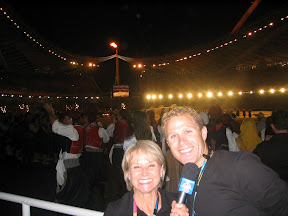
This year, I had a pleasant change of scenery. At the start of opening ceremonies, I was not sitting in a cool shady spot on the track. I was sweating like a pig in the athlete staging area along with all the other athletes. It must have been 85 degrees in the gymnastics hall where we waited for nearly two hours to march. It was pushing 90 outside when we walked to the stadium.

By the time I reached the stadium, my body was soaked in sweat; and I had consumed nearly a gallon of fluids to stay hydrated. The Ralph Lauren outfits were spectacular, but they were not designed to be cool and comfortable in extreme heat and humidity.

Four hours after arriving at opening ceremonies, Team USA finally made it to the tunnel that leads to the track. You could smell the sweat of thousands of athletes who had just passed through the tunnel. Nearly everyone’s faces were drenched with sweat from the heat. It was not comfortable.

Walking out of the tunnel onto the field is something I will remember for the rest of my life. Unlike Athens, this is my Olympics. The crowds waving US flags were waving for me and my team. A billion people would watch my Team USA compete now. The emotions are really indescribable.

After marching onto the field, we parked in our holding position and waited. By the time the torch was lit, we had been standing for nearly 4 hours. I was tired, jetlagged, and near exhaustion from two hard workouts earlier in the day. But it was all worth it. This time I was watching my opening ceremonies.

So maybe I took a bit of a demotion when I lost my infinity credential and picked up an athlete credential. I can’t go anywhere unquestioned anymore. Rather than sitting in the best seat to watch opening ceremonies, I had to stand for four hours. Instead of having a driver, I take public transit or an Olympic bus. But one thing is for sure: I have it way better off this Olympics than last.

Monday, August 4, 2008

Team Processing

Today I started the final leg of my long Olympic journey. After once again failing to finish packing early, I had stayed up until midnight tying up the final loose ends before leaving today. The punishment for my transgressions was about four-and-a-half hours of sleep and a 4:45am wakeup call to catch a 6:15 flight (I get dressed really quickly).

Normally I would take an Olympic Committee shuttle or taxi to the airport, but Cami wanted to see me off. At 5:30, Cami dropped me at the United desk and we said goodbye. That was probably the first time that it hit me that the Olympics are rapidly approaching.

After a layover in Denver, we arrived in San Francisco. A shuttle drove my team and about 15 other athletes and coaches to San Jose State University. Upon arrival, we were quickly checked into our dorm rooms, home for the next two nights, and given a brief overview of the next two days. Then came the fun part…

One of the big perks of making an Olympic Team is getting the Olympic outfits. I have been competing for years and scored numerous National Team uniforms, but Olympic outfits are legendary. They often set new fashion standards (think the Roots beret worn by the 2002 US Winter Olympic Team), and major apparel companies fight for the right to design and produce the outfits. This year is no different. Nike designed the athletic outfits and Ralph Lauren produced the opening and closing ceremonies outfits. And now that I have seen the outfits, I can say that both companies have risen to the occasion and produced spectacular apparel this year.

Processing takes about four hours total. Only about half that time is taken getting your Olympic apparel. The rest of the time you spend going over medical history, getting briefed on media relations, travel arrangements, and other Olympic rules. But by far my favorite part of processing was ordering my Olympic ring.

Nine years ago, I received my first significant ring, my Air Force Academy class ring. It is white gold with the Air Force Academy crest on one side and my class crest on the other. On the top of the ring sits a star sapphire surrounded by 8 small diamonds and rubies. I am very patriotic and I wanted my ring to show it. That ring is one of my most prized possessions earned by completing the rigorous program at the Academy. A few years back, I decided that if I earned an Olympic ring, I would design it to match my Academy ring. So the ring I selected today was white gold, has the Olympic Rings on the top, and will have a sapphire, ruby, and diamond on either side of the ring. It is the perfect addition to my incredibly small jewelry collection and probably the only ring that could displace my Academy ring from its place on my hand.

The last part of Team Processing is excess luggage shipping. Only about a third of all apparel distributed is mandatory for the Games. Because athletes have to travel with so much sport specific equipment, it is impossible to take all the apparel to China. So after receiving a shopping cart full of clothes and shoes, you decide what you really need, and ship the rest home.

It is finally starting to sink in that the Olympics are here. The excitement of the processing staff and the other athletes is palpable. It feels a lot more real to actually see opening and closing ceremonies uniforms, try on the podium attire, and buy the last few American products before going oversees. Tomorrow will be my last full day on US soil before competing. On Tuesday morning, my team and I will take the non-stop flight from San Francisco to Beijing China and the next leg of my Olympic journey. Opening Ceremonies are just 4 days away!

Monday, July 28, 2008

Uncle Jerry

One of the most interesting parts of my Olympic story is not about me, but it is about my uncle. In media interviews everywhere around the world, it is common for me to spend most or all of my time discussing our relationship. Given that my uncle’s name and image are recognizable around the world, it is not surprising that people want to know about our interactions. In reality, my uncle’s story and my Olympic pursuit have been linked for years. His work has given me a much stronger understanding of the roll the Olympics play in world affairs and in bringing pride to a nation. For those of you who don’t know, my uncle “Jerry” is known publicly as Ambassador L. Paul Bremer III, the man who oversaw reconstruction of Iraq from 2003-2004.

The first time that Jerry became involved in my athletic career was back in 1995. As a senior in high school, I had been dabbling in pentathlon for a couple years. My season had gone well, and I had achieved the qualification standard to compete in the Junior World Championships. The only problem was money. My sport federation was not supporting junior programs so I needed to raise the money myself to fly to Taiwan and compete. Jerry found out and bought my ticket and a few pieces of equipment I needed.

Five years later, I was visiting Jerry over the 4th of July. One morning at breakfast, he asked if I had any big plans for the rest of the summer. At the time I was on a break between graduating the Air Force Academy and starting my Air Force active duty job. I mentioned that I wanted to go to watch the Olympics in Sydney, but I had to see if airline ticket prices dropped to an affordable level. Three weeks later, Jerry called me up with a surprise. “Eli, my wife and I have decided that money should not be an issue and you should go watch the Olympics. Call my secretary and have her book you a flight.” Watching the Sydney Olympics was very inspirational, and I came home even more dedicated to my own Olympic pursuit.

Over the next couple years, I rose to the top of the US ranking list in pentathlon. I sent Jerry some shirts that said “Bremer, USA” on them, but I unknowingly sent him more than that. Jerry had seen me dedicate every facet of my life to qualifying for the Olympics and he saw how much impact the Olympics could have on people’s lives.

In 2003, I landed in Cairo mere hours after the US invaded Iraq. I had an opportunity to see first hand the rage in the streets, demonstrations, and massive anti-American sentiment. Interestingly enough, there was a tremendous amount of respect given to me and my teammate for daring to enter a predominantly Muslim country to peaceably represent our county in sports.

Within weeks of my return from Cairo, my dad called and told me to turn on the news. Jerry was being named to a new position. President Bush had appointed him the head of the Coalition Provisional Authority (CPA), the entity charged with civil reconstruction of Iraq. Within days, Jerry was on the ground in Iraq charged with the difficult task of undoing decades of societal decay in mere months.

During the summer of 2003, I continued my pursuit of the Olympics. I was one of only two US athletes to make the final at the 2003 World Championships in Italy. It was 115 degrees there and scorching. In Baghdad, 115 would have felt like winter in July. I was lucky enough to return home after my bout with the heat, while Jerry stayed in Iraq and wore a suit and tie every day in the sweltering heat to show an example of professionalism to the new Iraqi leaders.

Even before the air conditioning turned on (and that took a while) in the summer of 2003, Jerry took on an ambitious task. He decided the Iraqi people needed to see their team in the 2004 Olympics. Many people don’t know this, but Iraq’s Olympic Committee was decertified by the International Olympic Committee (IOC) following the US led invasion.

Prior to the invasion, Uday Hussein had run the Olympic Committee. Athletes were lavishly rewarded for good performances and tortured or executed for poor performance. The country’s Olympic infrastructure was, like the rest of the country, in shambles from years of corrupt and perverse operations.

The IOC decided that they would not allow Iraq to compete in the 2004 Olympics unless an entire new Iraqi Olympic Committee was created, starting with elections at the local level. Considering that Iraq had not held free elections of any kind in a generation, this seemed like an insurmountable task. But Jerry saw the value in giving this devastated country some much needed pride and worked to form the new Olympic Committee.

Months later, the first free elections in decades were held in Iraq, elections to create a new Iraqi Olympic Committee. After intense lobbying and work by my uncle, the IOC decided to allow Iraqi athletes to compete in the 2004 Olympics.

One day during the winter of 2003-2004, I received a call from Jerry in Baghdad. He asked if I was still doing most of my training at the Olympic Training Center (OTC) in Colorado Springs. He told me he was sending out a judo and wrestling team to train at the OTC and asked that I introduce myself and make them feel welcome. Weeks later, the small Iraqi team arrived at the OTC to prepare for the Olympics with the US Team. At the time, the US media was reporting that Iraqis were increasingly opposed to US led occupation and that anti-American sentiment was growing. I was unsure how the Iraqi team would view me, the nephew of the public face of US led occupation.

However, when the Iraqi team found out I was Jerry’s nephew, I was nearly dog-piled. I had grown men kissing me and nearly in tears. In a very emotional discourse of broken English, the Iraqis told me that Uday had tortured them and threatened them, but Jerry had given them hope and pride. During their stay, the Iraqis and I met several times. At one point, I arranged a conference call between the Iraqi team and my uncle in Baghdad. The Iraqis profusely thanked Jerry for his support and the opportunity to train in the US for the Olympics. In exchange, Jerry encouraged the Iraqis to be civil leaders when they returned home and to use their Olympic fame for the betterment of Iraqi society. Several weeks later, the Iraqi team returned home, ready to compete for pride of country rather than fear of torture and death.

When I failed to qualify for the 2004 Olympics, NBC hired me to work for them in Athens at the Olympics. At Opening Ceremonies, I was assigned to work with Andrea Joyce on the field. Andrea was going to conduct interviews with athletes after Opening Ceremonies, and my job was to find the athletes in the 10,000-strong gaggle on the field. During the Parade of Nations, we were able to sit back and watch the show. Three nations received standing ovations from the crowd in Athens: the Greeks, the US team, and the Iraqi team. I have rarely felt more pride than to see people from around the world acknowledge the significance of Iraq competing in the Olympics. An effort that my uncle had literally risked his life for was now the pride of the world.

During the Olympics, the Iraqi soccer team became one of the great stories. At a time when Iraqis factions rarely agreed with each other, the nation of Iraq could agree to support their Olympic soccer team. It was truly a unifying event for the people of Iraq and the nation.

At closing ceremonies, I encountered one of the heads of the Iraqi Olympic Committee. Not knowing how he felt about my uncle, I talked to him for several minutes before telling him who I was. When he saw my name on my credential badge, he responded like the Iraqi athletes had months earlier. He kissed me and told me that Jerry had likely saved his life and the lives of many other sportsmen.

Four years have passed since the 2004 Olympics. Today, Jerry has attempted to quietly step out of the spotlight and I have qualified for the Olympics. I recently had the chance to spend a day with Jerry in Washington DC, and we were able to talk about the Olympics, world affairs, and the normal family stuff. Jerry has always been an Olympic fan, but this year he has a much more personal reason to get involved and watch the Olympics.

I am extremely excited that Jerry, along with all the other friends and family who have helped me, will be able to see their efforts in my life come to fruition. As an Olympian, that may be the most significant part of going to the Olympics, the opportunity to thank your lifelong supporters with the act of representing your country in the Olympics.

I wish I could end this post on a high note, but as I was finishing writing this post, I saw some disturbing news headlines. Unfortunately, the success of the 2004 Iraqi team will not be revisited this year. The IOC has just announced that it is upholding a ban on the Iraqi team over internal problems with the Iraqi Olympic Committee. It is truly sad that the athletes and the people of Iraq will not have the inspiration or the common cause my uncle helped give them.

Sunday, July 27, 2008

Drugs and Money (Part 2 of 2)

There is an old saying that when you get together with family, you should not talk about religion or politics. In sports, it’s a little different; the taboo topics seem to be drugs and money. People want to know how drugs impact elite sports and how “amateur athletes” can afford the high cost of training (a few blogs ago I described how it costs about $200 per day to train, not including the opportunity costs of not working a regular job). Every time I talk to a group about the Olympics, I know someone wants to ask. Occasionally a brave soul has the courage to bring up one of these topics and is usually met with stern looks and embarrassment by the rest of the group. Because it seems to be a common theme of interest, I finally decided that it would make for a good blog. In part one, I addressed what I call the big elephant—drugs. Now for part two…

Recently I was talking to a community group about the Olympics. One individual raised his hand and asked a question about the Olympics and “professional” athletes. I assumed he was talking about basketball players who take a hiatus from the substantial salaries of club teams before donning the Team USA uniform at the Olympics. I told him that I believed if those athletes proudly represented their country with the pride and character expected of Team USA, they were a welcome addition. But in this case, the individual did not get the answer he wanted. After I answered several other questions, he again raised his hand and went on a minute long diatribe on how athletes should not be allowed to make money on sports and how doing so wrecked the essence of the Olympics. Honestly, I found it a bit insulting that this individual was suggesting that on top of the 10-12 hour days I put in, I should have another job and should not be allowed to seek corporate partners to support my dream of representing the USA in the Olympics. Despite this, I tactfully informed him that reason I was able to speak to his group for free, speak to over 5000 school kids last year, and hand out free trading cards was because my sponsors support and expect me to conduct public relations work.

Many people who come through the Olympic Training Center think athletes make small fortunes from prize money and endorsements. Furthermore, it is often assumed that the government subsidizes the Olympic Committee (the USOC actually receives no government subsidy and is funded only by corporate sponsorship). In reality, Olympic sports pay virtually nothing. A typical weightlifter of Olympic caliber might make $10,000 per year. Our top shooters (those who are ranked in the top 3 in the world) bring in around $25,000 per year in salary and prize money. For athletes just emerging on the national and international scene, few, if any, make money off their sports. A typical emerging triathlete might make $20,000-$30,000 per year in sponsorships and prize money and spend almost the same flying around the world to compete. Athletes with high visibility will make more money and a few of the top athletes like Michael Phelps score major endorsement deals, but most athletes make nothing more than the cost of training and competition. Small donor sponsors, including hometown family and friends, often subsidize the Olympic dreams of athletes. In my case, I have been fortunate enough to have the Air Force as my biggest supporter because I am an Air Force Officer (now in the Reserves). They help pay the bills and make it possible for me to train 6 days a week to be ready to compete against the best athletes in the world.

The question of “professionalism” still bothers some people, like the gentleman I mentioned earlier, even when they learn how little athletes make. I believe that allowing athletes to seek and retain sponsorships and endorsements is good for the Olympics. The main difference between “professional” Olympians and “professional” athletes from other sports is where they get their money. While a major league sports player earns his salary from the team, Olympians get money almost exclusively through endorsements. This requires athletes to be personable, professional, and presentable to the public. Because of this, most of the high dollar Olympians are exceptionally nice people who are excellent at sharing their Olympic Dream with others.

In most cases, Olympic athletes compete to represent the USA because we love what we do. Many athletes would make more money working minimum wage jobs, but the privilege of competing for your nation at the Olympics is really the best payment of all.

Wednesday, July 23, 2008

Drugs and Money (Part 1 of 2)

There is an old saying that when you get together with family, you should avoid conversation about religion and politics. In sports, it’s a little different; the taboo topics are drugs and money. People always want to know how drugs impact elite sports and how “amateur athletes” can afford the high cost of training (a few blogs ago I described how it costs about $200 per day to train). Every time I talk to a group about the Olympics, I know someone wants to ask. Occasionally a brave soul has the courage to bring up one of these topics but they are usually met with stern looks of embarrassment from the rest of the group. Because it seems to be a common theme of interest, I finally decided that it would make for a good blog.

Let’s start with the big elephant in the room—drugs. Going back about ten years, there was clearly a major problem with drug usage by US Olympic athletes. While it is unclear how extensive this problem was, the revelation that our highest profile athletes, specifically many in Track and Field, were using drugs severely tarnished the reputation of all US Olympic athletes. Perhaps the biggest reason for this problem was the structural setup of drug testing in the US (and internationally). The US Olympic Committee effectively conducted drug testing of its own athletes which created a problem of credibility and reliability. This is essentially the same problem that every major league sport has right now with their drug testing. From a credibility point of view, can an organization be charged with enforcement of drug policy when that very enforcement is likely to cause detriment to the performance and image of its athletes? Clearly it cannot. So the USOC created an independent organization called the US Antidoping Agency (USADA) back in 2000 to monitor illicit drug use in Olympic athletes. USADA is now completely independent of the USOC and has autonomous authority to test and sanction Olympic athletes both in and out of competition. This functional independence has created the credibility and capability to clean up Olympic sports. While the USOC has and always will always have the goal of making the US Olympic Team the best in the world and promoting the top athletes, USADA’s sole mission is to monitor athletes and keep the US athletes drug free. The conflicting goals work well and this setup makes a lot of sense.

Prior to USADA’s existence, there were major loopholes in the drug testing system. Today, USADA has a policy of no-advance-notice (NAN) out-of-competition (OOC) testing that makes cheating the system virtually impossible. We are required to keep location forms on file with USADA at all times and must consent to drug testing 24/7/365. I have had drug officers come to my house at 6:30am on a Saturday to conduct a NAN OOC test. In a given year, I am likely to get around six NAN OOC tests and the same number of in-competition tests. If I were to refuse a test or test positive for a prohibited substance, it would result in an automatic two year ban from Olympic sports. While this might seem highly intrusive to many of you, I believe it is a great system. Those of us who compete clean are fairly proud to prove it. Furthermore, with the strictest drug testing policies in the world, the US can be proud that their athletes are now probably the cleanest athletes at the Olympics. Being subject to NAN OOC testing is but a small price to pay for this credibility.