Thursday, July 17, 2008

The Treadmill Remains Undefeated

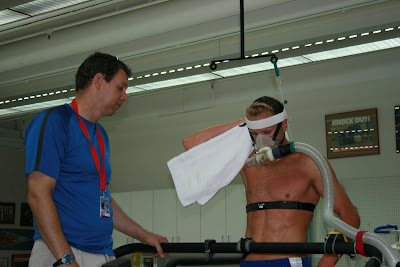
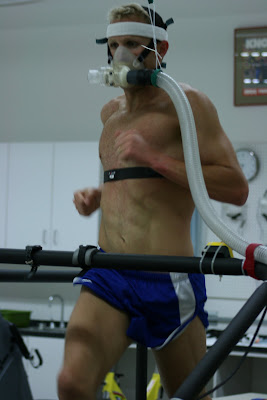
In my last blog, I posted some pictures of me running on a treadmill in the lab at the Olympic Training Center using supplemental oxygen. The treadmill in the lab (which I affectionately refer to as the “house of pain”) is not any old treadmill though. This specially made machine can go over 25 miles per hour, faster than any human. It is wider and longer than any commercially available model as well. Many of the best runners in the United States have been tested or trained on this treadmill. Those runners go on to win international competitions and beat the best runners in the world. Every one of them either has or will lose a race at some point in their careers. But because of its work over the years, the treadmill has a well earned tagline that reminds users to stay humble: “The treadmill remains undefeated.”

This morning, I once again went head to head with the treadmill for my Thursday morning supplemental oxygen run. At 5 weeks out from the Olympics, I could not be happier with my fitness and progress I am making. But this morning’s run would prove to be my biggest training challenge of my season… or maybe ever.

Before competing in the Olympics, I will go through a rest period to let my body fully recover and store glycogen, the body’s chief form of energy. Between now any my rest period, which will start in early August, I will be training harder than ever. So when I arrived at the lab this morning (Thursday) at 6am for my run, it had already been a long week. Since Monday, I had already swum three times for a total of 10 miles and run 26 miles including a difficult bout with the treadmill on Tuesday. Furthermore, this morning’s early start was not a welcome event for me.

After a 30 minute warm up, my running coach Alan dropped the bombshell on me. Today my workout would be running 3,000 meters in a simulated race. To make the simulation more real, I would do it at race pace. This was not totally unexpected, but it was completely unwelcome this morning. About 6 weeks ago Alan told me he would make me run a race simulation, but I expected it next week or the week after, and I expected it on a Tuesday when I would be more rested. But today was the day, and I trusted Alan knew what he was doing.

The objective of the run was to run the first kilometer in 2:55, the second in 2:50, and the final kilometer in 2:45. In mile pace, that is starting at 4:40 per mile and building to 4:24 per mile over a 1.82 mile distance. In layman’s terms, it’s really fast.

I did a few striders, short runs designed to loosen up my stride, to get going then got off the treadmill for a final stretching session before starting. Honestly, I find it a bit scary and intimidating to know how much pain I will make myself endure during a run like that, and we noticed that my heart started racing with anticipation and anxiety even before starting. Once I got up the nerve, I jumped on the treadmill and started my race. Within a minute, I could feel something was terribly wrong and I wondered if it was simply panic. 30 seconds later, things were getting worse and faster than simple panic or anxiety could explain. Then it hit me, maybe we had not turned back on the oxygen when I returned to the treadmill from stretching. With a frantic gesture to Alan, I conveyed my concern. He checked and confirmed that the oxygen was shut off and I immediately jumped off the treadmill.

About 10 minutes later, we took another stab at the race, this time with the proper oxygen supply. The difference was night and day. After 2:55 I made the comfortable transition to 2:50 pace and Alan recorded me at 174bpm or 92% of maximum heart rate. At 5:45, we again sped up to 2:45 pace and Alan recorded me at 181 or 95.7% of maximum heart rate. Ahead of time, Alan told me we could stop the race simulation if I exceeded 185 bpm or 98% of my maximum heart rate (it is pretty devastating to approach maximum heart rate and can take days to recover). At 7 minutes into the run, Alan said I could stop the race. Despite the pain, I felt I could tolerate it for 90 more seconds. Twice more, Alan told me I could stop if I wanted, but the competitive side of me kicked in and I determined to finish at all costs. At 8:30 I finished and clocked a 188 bpm heart rate or 99.4% of maximum heart rate. Despite the pain, I was ecstatic that I had completed the test.

Running that fast this far out from the Olympic gives me great confidence in where I will be five weeks from now. I don’t know if any other athlete will be able to match it at the Olympics, but I feel I am well on my way to having the fastest run/swim combination at the Games.

After the workout, I was talking with Alan and Randy (the USOC sports physiologist) about the run. Both were extremely impressed that I could post such a fast time in the middle of the season. After slapping each other on the back a bit, I turned to Alan and Randy and reminded them that regardless of how fast I had just run and how few, if any, other athletes in my sport could match me, we had to remember one thing: Unlike me, the treadmill still remains undefeated.

Tuesday, July 15, 2008

Supplemental Oxygen


I get a lot of questions about my running training, specifically about my supplemental oxygen training. Last year, National Geographic aired their production “The Incredible Human Machine” which featured my supplemental oxygen training. As promised, here is a full explanation of this high tech training technique.


The Olympic Training Center in Colorado Springs is located at around 6200 ft of altitude. That’s high enough that when I leave for a few weeks, I can feel the effects when I come back (and I grew up at this altitude). For years, we have known about the positive effects of living at altitude. When the human body is subject to the reduced oxygen of an altitude environment, it responds by increasing production of oxygen carrying red blood cells. A highly-trained athlete can expect to increase their red blood cell count by 15-20% when living at altitude. This assists the athlete in circulating oxygen to the body during workouts in a hypoxic (less oxygen) environment. But the real benefit is when you go to sea level. Because your body does not instantly revert to the lower number of red blood cells needed for the oxygen rich environment, you essentially have an artificially high ability to carry oxygen within your bloodstream. For me, this makes it possible to run and swim faster when I go to sea level. The effects are similar to blood doping (inserting red blood cells into the bloodstream via IV), but the practice of blood doping is both illegal and dangerous. Living at altitude is not.

There has always been one problem with training at altitude--it is impossible to train as fast as you can at sea level. It seems that no matter how much your body tries to compensate for the altitude by increasing red blood cells, you never feel the same at altitude. So for years there has been debate about whether the benefits of altitude, higher oxygen carrying capacity, outweigh the downside, lower speed in practice. Until now…


Recently some innovative sports scientists came up with a way for athletes to have it both ways. At the lab at the Olympic Training Center, we have supplemental oxygen machines. These contraptions, custom made with random parts including weather balloons, feed athletes 62% oxygen saturated air, roughly similar to the effects of training at sea level. I use supplemental oxygen (nicknamed SO2) training twice a week in running. With a gas mask on my face, I run on a specially designed treadmill that is wider, longer, and faster than any commercially available unit. In the synthetic, oxygen rich, sea level environment, I am able to push my body much harder than normal for 6200ft. This allows me to train race pace and faster frequently. In turn, my body is able to learn the mechanics of running at race pace, the muscles become adjusted to firing at that intensity, and my brain starts to accept that I am capable of running sea level times. This enables me to perform at a much higher level when I descend to sea level for a competition… for instance the Olympics.

SO2 training is a difficult way to train and has some downsides. First, it is expensive. I suck down almost $50 worth of air each session. It also requires two people to assist in running the apparatus and monitoring my heart rate, effort, and mechanics. As an athlete, it is pretty easy to get bored running on a treadmill for upwards of two hours. It is also extremely painful. The bodily chemical reaction that burns oxygen and carbohydrates produces lactic acid which floods your bloodstream. The more oxygen, the more lactic acid your body produces.

All in all, I think SO2 training gives me a big advantage in running. It gives a pretty big confidence boost to know that you have the physiology and endurance of an altitude athlete but the speed of a sea-level athlete.

Monday, July 7, 2008

A Capitol Fourth (Part 2)

The Fourth of July is by far my favorite holiday. I usually spend it in my hometown of Monument, Colorado which has a major 4th of July bash. It starts with a 4-mile race which I have never won (and that bothers me). The race always falls right in the middle of my hardest training so I am usually exhausted and not running well for it. It’s the biggest race in the Colorado Springs area that day, so all the good runners are there to make it a fast and fun race. After the race, the town of 30,000 gathers for the parade. Typically, everyone is either in the parade or watching it. Monument is still small enough that I see old high school friends and teachers every year.

It was a little bittersweet to be away from home on the 4th, but DC could not have been more fun. In the morning (and after an easy run on the hotel treadmill), Cami and I went along with the other athletes for a private tour of the US Capitol. Our tour guide was really knowledgeable and funny, and we learned a lot about the history of Congress and the Capitol building. After lunch, Cami and I met up with my aunt, uncle, and cousin who live just outside of DC for a tour of the Newseum. We had an “emergency” rehearsal the afternoon before the show because the producers did not like how we walked onto the stage, so I had to duck out of the Newseum for a quick jaunt back to the Capitol. After the Newseum, we had dinner and headed over to the Capitol for the performance.

It was raining for the last few hours before the performance, but no one in the crowd or in the show seemed to mind. Looking up at the Capitol from the stage, you could see the crowd of over 100,000 people, a number dwarfed by the onlookers on the mall. There were tons of American flags, and you could feel the excitement and energy in the crowd.

Our part of the show only took a few minutes and, if I do say so myself, we executed our part flawlessly (of course, we could not really screw up walking 10 feet and standing on a platform while music played!). Looking beyond the stage, we could see the Washington Monument in the distance. It was one of those experiences I will never forget as long as I live.

After the show, we attended a reception in the Capitol building. Cami and I got a good laugh when we ran across a notice in the transportation vehicles stating that athletes would ride in the motorcade, but Congressmen needed to walk. We have a picture of the notice on the photo album page of elibremer.com.

The reception was a lot of fun, and again they honored the Olympians in the room as well as the performers at the event. We stayed at the party until almost midnight, then headed back to the hotel.

While I love being home for the 4th of July, this experience was worth the change-up. I love representing the USA, and seeing the nation honor and support our Olympic Team brought more pride than I can describe. It has been described that the Olympic Team is America’s Team. It really felt like that this weekend, and it reminded me how fortunate I am to represent the USA in the greatest sporting event on the planet.

Friday, July 4, 2008

A Capitol Fourth (Part 1)

A couple weeks ago, Cecil, my media relations guy (no really, I don’t know his proper title) called me up and asked if I wanted to go to Washington DC on the 4th of July. The organizers for the celebration on the steps of the US Capital wanted some Olympians to be on stage for the show in a tribute to the US Olympic Team. While to me, being in DC on the 4th would be like being in New Orleans for Marti Gras for most people, I told him I probably should stay home and train. The next morning when my alarm clock went off, I suddenly realized I had totally blown it. As soon my morning swim was over, I called Cecil and told him I wanted to participate if at all possible. Going to the Olympics is cool, but who in their right mind would turn down the opportunity to be part of the national celebration on the 4th of July?

Fortunately, my window of opportunity had not expired and the event organizers were happy to have me participate. About a week ago, they bought my ticket, booked my hotel, and I was ready to go.

Cami decided to come out with me and we arrived early this morning. Today, there were introductions and a rehearsal at 2:00. Scott Hamilton is doing the announcing and we met him in the hotel lobby. He was very down to earth, and was spending the bulk of his energy chasing after his son.

I also ran into Dominic Grazioli, an Olympic shotgun shooter, who is also an Air Force Academy graduate. We had never met, but had a good time talking during the course of the afternoon.

The first practice show went slowly. We spent a lot of time in our ready area, but that gave me a chance to talk to Scott Hamilton a bit. I remember watching Scott skate when I was younger, so it was a real honor to be able to sit down and have lunch with him. Like most of the Olympic greats I have met, Scott turned out to be both a great athlete and great person.

After the first practice, we had a few hours off so Cami and I decided to check out the Smithsonian exhibit on the US Olympic Team. It took a while to walk across the Mall to see the small exhibit, but it was worth it. From the Smithsonian, we returned to the hotel for some rest before the evening dress rehearsal.

The second practice and dress rehearsal started at 7:15. Our hotel is just down the road from the Capitol, but we took a van anyway. After sitting around for a while, I decided to check out the show. Tyler Hicks and Johnny and the News were performing so it was a pretty good show. There were tens of thousands of people watching the dress rehearsal, but hundreds of thousands are supposed to show up for the real thing (I heard that it’s somewhere around 400,000).

After our rehearsal, the other athletes and I spent a while signing autographs and taking pictures with kids at the rehearsal. It was great to see so many kids excited about the Olympics and cheering us on.

Tomorrow will be the real deal. The producers are concerned about the weather, but the show is going on either way. As it turns out, I have an aunt and uncle in town who are going to come down to watch the show. I have not seen them in years and they have never met Cami, so that will also be a high point for tomorrow.

Cami is taking pictures and video, so I’ll try to put them up shortly on my website. If you want to watch the show, tune into PBS the evening of the 4th and we will be on!

For those of you viewing this blog on USA Today, you can view photos later at www.elibremer.com.

Sunday, June 29, 2008

Trials and Tribulations

I have been a resident athlete at the US Olympic Training Center for 7 years now. While that is nowhere near a record, it is long enough to get to know many other athletes from different sports. That’s one of the best things about the OTC, being in an environment where you are surrounded by like minded people all pursuing the same dream.

There are 8 resident sports at the OTC and numerous other that come in as “camps.” All in all, I probably have friends in 12 different Olympic sports right now. Each sport has its own way of qualifying for the Olympics. Pentathlon essentially uses solely an international system, meaning you win your slot oversees by competing against other countries. Swimming would be the diametric opposite where a swimmer could win Olympic Trials without having ever set foot outside the country or competed against internationals. Most sports fall somewhere in between pentathlon and swimming and have a relatively complicated selection process. Because of this, most of us at the OTC quest our friends in other sports to learn about their qualification system and what it will take for our friends to qualify.

While I was fortunate enough to secure a slot last summer, most Olympic selection takes place during the spring of the Olympic year. This creates a fairly strange environment around athletes as tensions rise, and suddenly teammates find themselves pitted against each other for a final Olympic slot. In every case, it seems there are great athletes who will be left off the team because there are only so many slots. As an athlete already qualified, it’s hard to balance the excitement of knowing you are going with interacting with your friends, who have worked just as hard as you, who did not make the cut. Having been in their shoes four years ago, I can tell you that it’s not fun to watch the Olympics you thought would be yours come and go without your participation.

Olympic team selection is really a mixture of emotions. I train with and am friends with our top two fencers; one made the team, the other, a returning Olympian, did not. In weightlifting, I had friends I have known and respected for years make the team, and some who did not. Triathlon, which concluded its final Olympic selection last weekend, qualified two good friends of mine, but left many more off the team. And wrestling can be described as nothing short of carnage. My new business partner, a returning Olympic Bronze Medalist, failed to make the team. More World Medalists failed to qualify than I can count, including several friends of mine.

But all elite athletes know that qualifying for the Olympics is tough, and there is a lot of excitement around watching every sport pick their Olympic Team. This week, I have two friends and fellow graduates of the Air Force Academy competing in Track and Field Olympic Trials. Both have a good chance of making the team. Needless to say, I am watching NBC every night this week to check in on them.

So Olympic Trials season is a real roller coaster for athletes, even if you have already qualified. It reminds you how great it is to win your slot on the team, but it’s also humbling to see other great athletes who you respect not make it. For every athlete celebrating after winning an Olympic berth, there are five who go home and try to find the courage to train every day for another four years on the chance they will make it next time. It’s a strange set of emotions to go through. Having now been on both sides of qualifying for the Olympics, I try to celebrate with my friends who qualified and be respectful of those who did not, knowing their sacrifices and dedication were as great as mine.